10mm scale corresponds to 1/161 scale, which is almost exactly "n" gauge for model railways, so this means that n-gauge scenery can be used with no problems.
One of the things I've considered buying is more cheap wire trees and I wanted to know how big I could go with their height before it became unrealistic. - The problem with doing research into trees and rivers as a job is that I'm going to be applying an unnecessary level of detail into making sure my rivers and trees are as accurate as they can be!!
The ones I bought from Ebay the other week were 35mm, 38mm and 40mm respectively. These correspond to roughly 4.8m, 6.5m and 8m at scale. Typically this is going to correspond to young trees from the common Beech, Birch, Maple, Chestnut families, and mature Holly, Mountain Ash, Cherry, Hawthorn, and other members of the Rose family. It's worth pointing out that any coloured model trees (which are quite widely available) and represent blossoming fruit trees are going to be a bit large at anything over 50mm tall (10m), as that is about the maximum height.
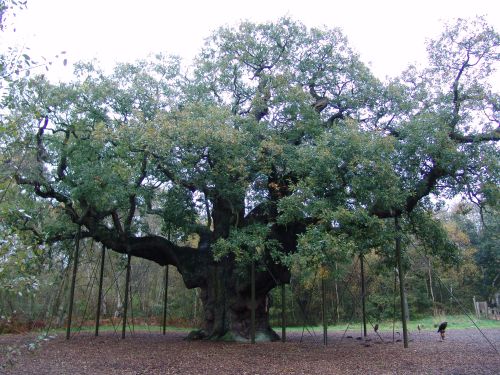
Typical mature ancient woodland would be best represented by trees that are 75mm (12m), 100mm (16m) and 150mm (24m). These sizes will correspond to typical mature trees of the Beech & Birch families, where they typically have maximum heights in the 15-25m range. Another popular tree model is the willow, where heights are about the 8-20m range depending on sub-species (40-120mm)
For pine type tress you can go a little bit larger, but the advantage of pine trees is that they don't loo
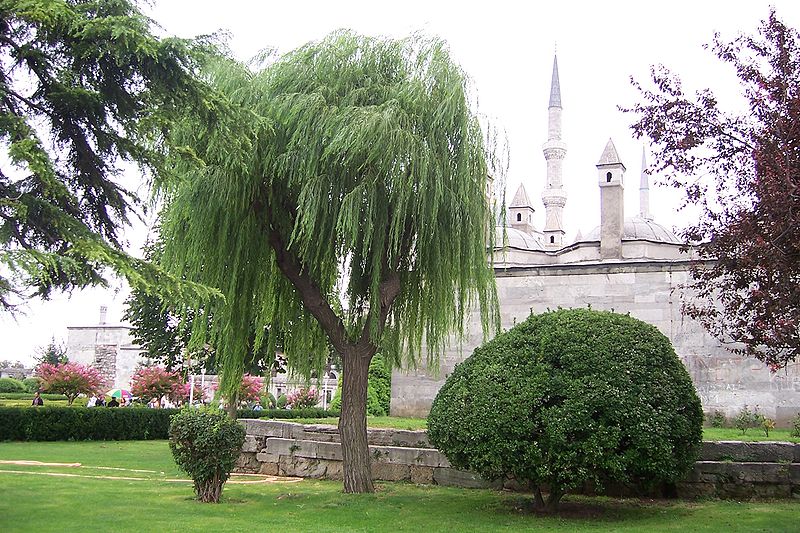 k that different at any life stage, so there is the opportunity for people like me who play at different scales to make a scenery piece that can be used across different games. For maximum heights of Scots Pine & Douglas Fir, you are looking at 35m and 55m respectively, which is 220mm - 340mm!!
The problem with all of these facts is that a lot of wargamers have been raised on a diet of Warhammer with its oddly proportioned buildings and trees. Wargames naturally involve a lot of abstraction and I've no problem with this at all. However being used to the relative sizes of buildings and trees in Warhammer, true scaling in your 10mm games may look a little odd! For example a typical mid-size pine tree in Warhammer at scale would be around 45cm tall, the largest typical examples of Douglas Fir are going to be nearly a metre tall!! But on the table-top you are unlikely to see any trees much taller than 15cm.
For these reasons I am planning to stick to trees no taller than 10cm, as any more, although in scale, will look daft. Hopefully though this will have the advantage that my towering 16m plantations for Warmaster can be pressed into service as 5m tall arboretums for Warhammer as well.
Ultimately although 10mm wargames correspond to n-gauge model railways, you can safely use packs of HO or OO trees with no problem at all and you can even get away with nearly O gauge ones for particularly large trees.


